

Domestic Abuse and Mental Health
THCVS is working with a partnership of 12 organisations to support Tower Hamlets residents to better understand domestic abuse and to access early support.
The programme is supported by and works with the Safeguarding Adults Board, GP Care Group, VAWG, East London Foundation Trust talking therapies and Solace Women’s Aid in order to ensure effective referral and support for vulnerable residents.
Domestic Abuse 24/7 Helpline
0808 2000 247
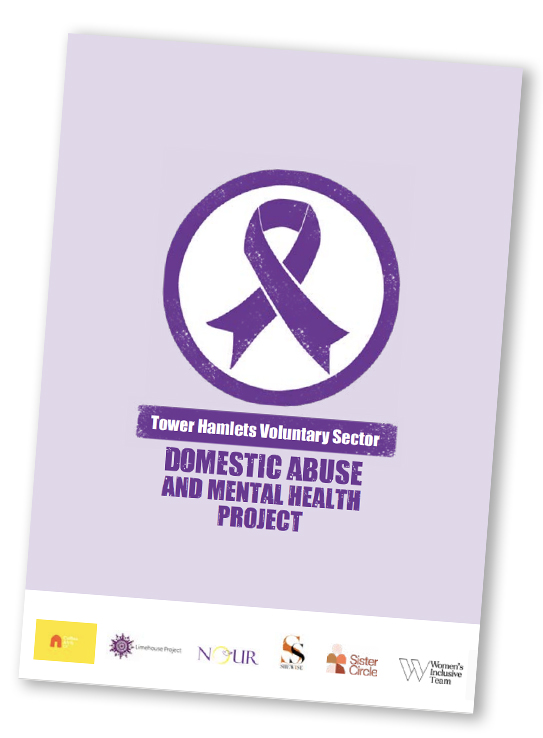
Click here to read the Tower Hamlets Voluntary Sector Domestic Abuse and Mental Health Project leaflet.
Meet the partners
A trusted bridge: Women’s Inclusive Team on domestic abuse and mental health
How a community-rooted organisation in Tower Hamlets combines trusted advocacy, practical support and awareness-raising to help people recognise abuse, protect their wellbeing and rebuild their independence.
Support shaped by the community
Women’s Inclusive Team (WIT) grew from a simple but powerful act of mutual support. Founded in 2004 as the Somali Integration Team, it began when a small group of Somali mothers in Tower Hamlets came together after having their first children. They shared feelings of isolation, uncertainty and difficulty navigating services that did not always feel accessible or culturally appropriate. From those grassroots beginnings, WIT has developed into an organisation supporting women from disadvantaged backgrounds, their children and wider families across Tower Hamlets and, where funding allows, neighbouring boroughs and pan-London communities.
At the heart of its approach is what the team calls a “holistic hug”: a woman may first seek housing advice, but the conversation may reveal concerns about childcare, special educational needs and disabilities, domestic abuse, financial control or mental health. WIT responds by connecting her with its own services and trusted partners. Its work includes advice and guidance, nursery and youth provision, SEND support, community connectors, mental health activity and the Howa domestic abuse project.
Recognising abuse and protecting wellbeing
Many people who approach WIT do not initially identify their experience as domestic abuse. Public understanding can still focus narrowly on physical violence, while coercive control, financial abuse, restriction and isolation may be normalised or go unnamed. WIT helps clients understand different forms of abuse, their rights, the features of a healthy relationship and the practical options available to them. Crucially, it offers a trusted and culturally aware space for people who may not feel able to approach mainstream services.
Domestic abuse and mental health are closely connected. Fear, control and prolonged harm can affect a survivor’s emotional wellbeing long after an immediate crisis, while poor mental health can make it harder to seek help or navigate complex systems. By discussing the two together, WIT can identify needs earlier and offer support that addresses safety, recovery and the wider circumstances affecting a family.
Taking awareness into everyday spaces
Alongside one-to-one advocacy, WIT works with local organisations, health services and community venues to make information visible and approachable. Regular workshops explore women’s safety, wellbeing and mental health. The team has collaborated with Tower Hamlets services, local GP practices and other community partners, and uses campaigns to explain the signs of abuse and where support can be found.
A bus-stop campaign for the 2025 16 Days of Activism placed messages about the signs and symptoms of abuse in busy public locations. Such communication can reach people WIT may never meet directly, helping someone recognise what is happening and make an informed decision. Workshops also equip volunteers and community leaders to share knowledge through their own networks, creating a wider and longer-lasting ripple effect.
Inclusion also means considering how people access buildings, information and events. WIT’s venue offers wheelchair access and staff provide practical support to attendees with disabilities. Feedback from Vision Ability has helped the organisation improve colour contrast and strengthen the accessibility of its website, including compatibility with audio tools. The team is continuing to consider accessible formats and the needs of people with sight or hearing loss.
Trust that can change lives
One anonymised case shows why trusted, responsive advocacy matters. A woman first encountered WIT while accompanying a friend and, after seeing the support available, disclosed that she was experiencing severe abuse. During the period in which WIT supported her, an adviser remained connected during an immediate threat and contacted the police, enabling emergency intervention and helping the woman reach safety. She was subsequently rehoused confidentially and, at the time of the interview, was reported to be doing well. The account illustrates how an accessible community service can enable disclosure, coordinate urgent action and remain alongside someone through recovery.
Recovery is also about rebuilding confidence and independence. Through work at the Nari Centre, women identified driving as an important step after leaving controlling relationships in which a partner had always driven. WIT responded with theory-test sessions, turning what might seem like a practical goal into a route towards greater autonomy. The team has also seen growing engagement from the Bangladeshi community, demonstrating how trust can spread across communities when support is consistent, welcoming and rooted locally.
Partnerships that keep the focus on people
WIT’s impact depends on strong referral routes and collaboration. Its inclusion in the Tower Hamlets referral system is helping professionals connect people with support, while partnership activity at the Nari Centre and coordination through Tower Hamlets Council for Voluntary Service help organisations work around a shared purpose: meeting community need rather than operating in isolation.
Funding remains a pressing challenge. Short funding cycles can place proven services under strain even when demand is clear. WIT’s message is that awareness activity, culturally responsive advocacy and partnership infrastructure must be sustained. The organisation intends to keep listening, learning and adapting with local people and partners so that support becomes stronger and more inclusive.
“A problem is never too small and a problem is never too big.” WIT encourages anyone who is worried about themselves or someone else to start a conversation. The team will offer support where it can and involve specialist partners when needed. Its commitment is simple: to remain a trusted bridge, strengthen local services and help people move towards safety, wellbeing and independence.
Visionability CIC: making domestic abuse and mental health support accessible.
Visionability CIC is helping visually impaired and disabled residents get the support they need. As a satellite partner in the Domestic Abuse and Mental Health partnership, it creates safe, informal spaces to learn about abuse and talk about mental health without judgement. People can find out where to get help before reaching crisis point. Coffee mornings have been particularly valuable, bringing residents and partner organisations together in a trusted community setting.
Through this work, Visionability CIC has identified the need for more direct support. This includes a developing talk and offer for visually impaired survivors and residents affected by mental health challenges. The organisation also helps partners build accessibility into services, events and communications from the start. This includes large print, accessible digital information, verbal explanations, telephone and language support, braille, audio, easy read formats and practical help with travel or appointments. Their message is clear: accessibility is not optional – it is essential if people are to be heard, believed and supported.
Click here to find out more about Vision Ability.
The partners - and the support they provide
Delivering workshops and support to young people
- Coffee Afrik works to ensure culturally sensitive approaches to mental healthcare in Tower Hamlets, and offers support to young people.
- Shewise brings an expertise of working with south Asian women and girls on domestic abuse and mental health.
Workshops and support package for all groups
- The Women’s Inclusive Team’s Haawa Project works with women and girls to prevent violence and abuse and ensuring survivors find safe and culturally sensitive support. Through 1:1 tailored support, Educational Workshops and train stakeholders on understanding cultural needs.
- Limehouse Project provide a wide range of advice, support, education and employment training services for communities. With experience of supporting women affected by domestic abuse and mental health issues to access support.
- Nour provide trauma-informed, culturally competent services to adult survivors of abuse, including, but not limited to, survivors of domestic abuse, sexual violence and childhood abuse.
- Sister Circle support women in challenging circumstances to lead healthy lives through service provision, advocacy and peer support.
Providing support with co designing the workshops for target groups.
- Carers Centre support carers aged 16+ through a carers forum, carers academy and regular newsletters and access to advice and guidance.
- Christ Apostolic Church links into faith communities via the Interfaith Forum and is able to bring diverse faith perspectives.
- Ocean Women’s Association bring experience of supporting vulnerable Bangladeshi women.
- Somali Senior Citizens Club bring experience of supporting older vulnerable Somali men and women.
- Vision Ability bring expertise in supporting people with visual impairments and are linked to the disability network.
Wellbeing support for all through arts activities
- Paracarnival brings expertise around supporting vulnerable people through arts programmes.
VAWG and London Borough of Tower Hamlets
- For information about domestic abuse training for professionals, please contact Serita Myers, at Serita.Myers@towerhamlets.gov.uk.
- For further information on the VAWG strands and to become a VAWG Champion, please contact my colleague, Amy‑Kate Garwood, at AmyKate.Garwood2@towerhamlets.gov.uk.
- If you have concerns for an individual/family, you can signpost them to support via the Tower Hamlets Violence against Women & Girls (VAWG) Directory: www.towerhamlets.gov.uk/VAWGServiceDirectory.
- The VAWG Service Directory lists local and national VAWG support services for victims and perpetrators of abuse.
For Domestic Abuse topics – Domestic Abuse training external application form.
For VAWG Champion dates – VAWG Champions course application form.
For other VAWG topics – VAWG training external application form.
Bangla UK Talk Show on Domestic Abuse & VAWG
Cllr Kabir Ahmed, Cabinet Member for Safe Communities and Community Cohesion, joined other distinguished guests to discuss Violence Against Women and Girls (VAWG). During the 90-minute live show, Cllr Ahmed highlighted the work that Tower Hamlets Council is doing to tackle domestic abuse and violence against women and girls. He also discussed the support and services available through the Nari Centre for women and girls in Tower Hamlets. The program featured the Council’s VAWG video content, and an Imam joined via Zoom to provide an Islamic perspective on the issue.
https://www.youtube.com/live/sPvHc9r3Xqc?si=shFbZu4rVUrueG_T
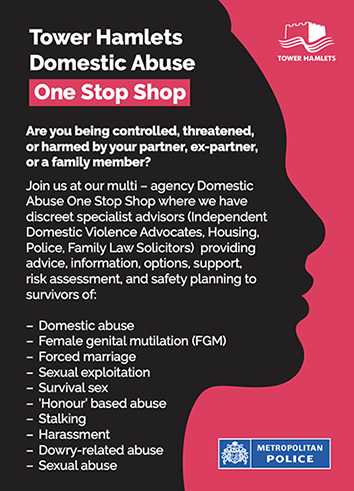
Tower Hamlet’s Domestic Abuse One Stop Shop
The Tower Hamlet’s Domestic Abuse One Stop Shop is now open offering a weekly drop-in service every Monday morning, providing vital support for women affected by domestic abuse.
Location: Women’s Resource Centre (Nari Centre), 61 Vallance Road, E1 5BW.
When: Every Monday morning / 10:00am – 12:00.pm
What’s available:
- Domestic abuse support services.
- Housing advice from a dedicated advisor.
- Legal guidance from a local family law service.
- Police presence – with the option to report or simply seek advice.
Campaigns
Refuge - Home Is Where the Hurt Is
Refuge have released a new awareness video ‘Home is Where the Hurt Is’ to highlight that home is the most dangerous place for many women. Their campaign exposes hidden forms of control, including tech‑enabled abuse, and asks viewers to “take a tour around this seemingly picture-perfect house, can you spot the red flags for abuse?”
Domestic abuse incidents often rise during major football tournaments including the 2026 World cup, prompting targeted awareness campaigns and support initiatives.
Legislation - Criminalising Sex‑Based Harassment
A new law was introduced on 1st April 2026 criminalising sex‑based public harassment, giving police stronger powers to act decisively and enabling penalties of up to two years’ imprisonment. The legislation aims to protect women and girls from intentional harassment, including intimidating behaviour, in public spaces such as streets, parks, transport, shops.
“As the Protection from Sex-Based Harassment in Public Act comes into force, we now have clear guidance that names these behaviours for what they are: illegal and unacceptable.” – Rose Caldwell, CEO at Plan International UK.
Click here for more information.
‘Honour’-Based Abuse - New Legal Definition
The government has introduced the first statutory definition of ‘Honour’-Based Abuse within the Crime and Policing Bill alongside a power to issue statutory guidance for services to better support and protect survivors. This milestone follows the #Push4Change campaign by Karma Nirvana, launched in memory of Fawziyah Jave. The definition and guidance aim to improve identification, consistency and protection for survivors, addressing long‑standing gaps in safeguarding and accountability.
Stalking – Gaps in Identifying High Risk Stalking Behaviours
The Suzy Lamplugh Trust’s new report highlights that stalking is frequently misidentified or minimised, including in Domestic Abuse Related Death Reviews (DARDRs), despite strong evidence linking it to fatal violence. Research shows stalking behaviours appear in the vast majority of cases where women are killed by men, yet gaps in data collection, risk assessment and professional awareness persist. The report calls for strengthened research, improved data collection, and the introduction of a dedicated stalking-related death review process.